Resurfacing can soften roughness and make the surface look brighter and more uniform.
Consultation-led aesthetic medicine · Brighton & Hove · By appointmentConsultation-led · Brighton
TEXTURE · PIGMENTATION · RESURFACING
TCA resurfacingFor sun damage, lines and rough skin.
TCA Refresh or TCA skin resurfacing, chosen for your skin and the change you want.
At a glance
TCA
Trichloroacetic acid.
In my own words
TCA is one of my favourite treatments.
If I had to choose three treatments for beautiful-looking skin, TCA would be one of them.
It is one of my go-to treatments for discolouration, freckles and uneven skin tone.
Personally, I have TCA skin resurfacing once a year, sometimes followed by a lighter TCA Refresh during the year to maintain the result.
What matters is whether the improvement you are hoping for is realistically achievable, and whether the recovery fits your life. During your consultation, I will assess your skin, explain what TCA could offer you and talk you through the healing process and the support I provide. You can then decide whether it is right for you.
Selected brown marks left after spots or irritation may become less noticeable.
Freckles and sun-related pigmentation can become less noticeable.
Remodelling can encourage new collagen formation, without replacing lost facial volume.
Quick overviewYour appointment at a glance
- TCA Refresh
- 90 minutes. £200 per treatment (£170 when repeated within three months). Assessment is included in the appointment.
- TCA skin resurfacing
- 150 minutes. £475, including the Epionce recovery kit. A separate consultation is required before treatment.
- Consultation
- 60 minutes · £50, credited in full towards a future treatment. A separate consultation is optional for TCA Refresh.
- Preparation
- Your preparation instructions arrive before treatment. The products and timing are chosen for your skin and the planned peel.
- Recovery
- Refresh has a lighter, faster recovery. For TCA skin resurfacing, allow approximately 7–9 days for visible healing; redness can last longer.
- Aftercare and booking
- After TCA Refresh or TCA skin resurfacing, I encourage you to share photographs of your recovery so I can follow your healing and guide your skincare. How I support you during recovery → Choose your appointment and view current fees.

The complete conversation
Your questions about
TCA resurfacing
What TCA can improve in lines, texture and pigmentation, how Refresh differs from deeper resurfacing, and what recovery involves.
odNOVA guide
- 1You
- 2Piotr
- 3Clinical
- 4In depth
Choose a question
What is TCA resurfacing?Piotr answers
Piotr
With a TCA peel, I use trichloroacetic acid to encourage your skin to repair and renew itself.
The acid denatures proteins in the treated layers — in other words, it changes their structure. This starts the healing process.
Over the following days, you will see the treated skin begin to peel away as new skin develops underneath.
TCA can be used for lighter exfoliation or deeper resurfacing, depending on the formulation and how it is applied. [2]
How else does TCA work?
With deeper TCA treatment, the repair process also stimulates new collagen formation beneath the surface.
Alongside remodelling of elastic fibres, this helps renew the structures that give your skin support and flexibility.
These changes develop as your skin heals, continuing beyond the visible peeling stage. [11]
How does TCA Refresh differ from TCA skin resurfacing?
TCA Refresh is the gentler of the two TCA treatments I offer.
It is intended for texture and tone when you would prefer a less intensive recovery, or as part of a gradual course of treatment.
TCA skin resurfacing works more deeply.
It can produce a more pronounced change in sun-damaged texture, but treatment is more uncomfortable and healing is more visible.
The choice depends on how much change your skin needs and how much recovery you can manage.
Refresh can also be useful after a previous TCA skin resurfacing treatment, when a lighter approach is more appropriate.
What can TCA improve, and what are its limits?Piotr answers
Piotr
TCA can soften lines, smooth rough texture and fade selected areas of pigmentation, helping your skin look fresher and more even.
It may help with freckles, sun spots and some brown marks left after inflammation, known as post-inflammatory hyperpigmentation. It does not replace lost facial volume or lift loose tissue; those changes need a different approach.
Is TCA good for acne scars?
TCA can improve some shallow acne-scar texture across the treated area.
Deep narrow scars and scars pulled down by tissue underneath need a different approach.
TCA CROSS treats selected individual scars.
Other scar types may respond better to treatments such as subcision or a combination of procedures.
Is TCA CROSS the same treatment?
Both use trichloroacetic acid, but the technique and concentration are different.
TCA resurfacing treats a broader area of skin.
With TCA CROSS, I apply a small amount of a usually higher concentration directly into selected scars, so treatment is focused on each scar.
Why choose TCA, and does its strength matter?Piotr answers
Piotr
TCA skin resurfacing can reach much deeper into the skin than the superficial clinical peels I offer.
This allows me to treat changes in skin texture that surface exfoliation alone may not address.
Strength matters.
The percentage is only part of it: your skin, its preparation, the formulation and how the peel is applied all influence the treatment depth.
A higher percentage does not automatically make a peel more suitable. [2]
TCA skin resurfacing needs careful aftercare while the treated skin renews. As with ablative CO₂ laser resurfacing, caring for your skin throughout recovery is essential to healing well. I will guide you through each stage. [4] [12]
Is TCA more intensive than a superficial clinical peel?
The TCA treatments I offer are more intensive than my superficial clinical peels.
Refresh is the gentler TCA option; TCA skin resurfacing is intended for a deeper change.
For fine surface roughness or dullness, a superficial clinical peel may be enough, with less disruption while your skin recovers.
Is the same TCA concentration always used?
No.
The concentration and application depend on the area and the change being treated.
Skin does not have the same thickness or sensitivity everywhere, so a single percentage cannot describe the whole treatment.
What does research show about the results?Piotr answers
Piotr
Studies support improvement in sun-damaged skin, including texture and lines, but they do not give one reliable percentage for everyone.
In one study of 40 women, five TCA-based treatments were followed by improvements in measured hydration and skin elasticity.
The authors reported greater wrinkle reduction with 35% TCA, although wrinkle measurements were taken only in selected participants, so there is no dependable average reduction to quote. [1]
In a separate study, clinicians rated roughness as improved in 24 of 32 women (75%) and pigmentation in 26 of 32 (81.3%), four weeks after three monthly treatments with 6% TCA plus 12% lactic acid.[13] At odNOVA, I use higher TCA concentrations than the 6% tested in this study. These results relate to the specific combination and treatment course studied. The study included accompanying skincare and had no comparison group.
Research and results
Some studies below look at changes in ageing skin, while others examine complications or preparation and healing. Four concern repeated lighter peels for melasma or active acne. The treatments used different strengths, combinations and schedules, so those four studies cannot predict the result of one TCA skin resurfacing treatment.
Kubiak et al. (2020) · Sun-related skin changes · 40 women
After five fortnightly treatments, measured hydration increased by 39.5% with glycolic acid plus 15% TCA, and by 13.8% with 35% TCA alone.
Pigment measurements fell by 15.8% and 6.9%, respectively, three months after the course.
These are changes in device readings, not percentages of visible rejuvenation. Both groups also used the same skincare; there was no untreated comparison.
Study details and original results
Who was studied? 40 women aged 41–60 with facial photoageing, in two groups of 20.
Allocation and masking methods were not reported.
Treatment and timing.
Five fortnightly sessions: 70% glycolic acid followed by 15% TCA, or 35% TCA alone; final assessment about three months after the course.
What was measured?
The hydration and pigment results above are instrument measurements.
Around three months after the five-treatment course, the measured elasticity index had increased by 132.3% with 35% TCA and by 112.5% with 70% glycolic acid followed by 15% TCA. These figures describe a device measurement, not a percentage improvement in visible firmness. The difference between groups was not statistically significant.
Separately, the paper reports good/very-good overall improvement ratings of 89% with glycolic/TCA and 94% with TCA alone; the denominators cannot be reconstructed from the groups of 20.
What limits this result?
No untreated group.
Printed response percentages cannot be reconstructed from groups of 20.
The authors describe greater wrinkle reduction with 35% TCA, but PRIMOS wrinkle measurements were taken only in selected participants.
No reliable group-average wrinkle-depth reduction is available.
Treat this as limited supporting evidence, with no longer-term durability estimate.
Fanning et al. (2023) · Tone and texture · 32 women
After three monthly treatments with 6% TCA plus 12% lactic acid, clinicians recorded improvement in brightness in 29/32 women (90.6%), pigmentation in 26/32 (81.3%) and roughness to the touch in 24/32 (75%).
These are the proportions of women rated as improved, not the percentage improvement in their skin. This was a lighter combination peel, not TCA skin resurfacing.
Study details and original results
Who was studied?
Thirty-three women enrolled and 32 completed the study, aged 36–59 with mild-to-moderate facial photoageing and skin types I–V.
Treatment and timing.
Three treatments four weeks apart, using a commercial TCA/lactic-acid combination and accompanying skincare. Final assessment was four weeks after the last peel.
What else was found?
Mean clinician-rated severity scores fell by 37.9% for brightness, 37.2% for pigmentation and 34.5% for roughness to the touch. Overall appearance improved in 28/32 women; deeper wrinkles did not improve on average.
Recovery and adverse effects.
The authors reported one brief swelling event, one lighter patch that resolved within six weeks, and two acne flares treated with antibiotics. Practical downtime was not measured.
What limits this result?
There was no control group and only short follow-up. The study was funded by the product manufacturer. Results apply to the combination and its accompanying care; they do not isolate TCA or predict the outcome of full resurfacing.
Fanous & Zari (2017) · Safety · 923 patients
Persistent pigment darkening affected 54 of 923 patients: 5.9%, or about 1 in 17.
- Visible small blood vessels: 3 patients (0.3%).
- Herpes infection: 2 patients (0.2%).
- Bacterial infection: 2 patients (0.2%).
- Lighter patches: 1 patient (0.1%).
- Scarring: none recorded.
Average follow-up was 13 months. These figures describe one practice using different TCA depths; no recorded scarring does not mean there is no risk.
Study details and original results
Who was studied? 923 patients receiving facial or neck TCA peels in one practice over 1996–2015; a retrospective series.
Treatment and timing.
Different 30–45% TCA protocols and depths.
The protocol included prepeel preparation, generally for 3–6 weeks, using retinoic acid, an alpha hydroxy acid and hydroquinone, alongside moisturiser and broad-spectrum sunscreen.
Mean follow-up was 13 months; this was a safety observation, not a durability trial.
What was measured?
Persistent hyperpigmentation: 54/923; visible small vessels: 3/923; herpes: 2/923; bacterial infection: 2/923; hypopigmentation: 1/923.
Herpes and bacterial infection each affected 2/923 patients: about 0.22%, or 1 in 462.
Scarring was recorded in 0/923.
What limits this result?
Selection, retrospective reporting and mixed treatment depths limit transfer to other settings.
Zero recorded scars does not mean the procedure cannot scar.
The study did not establish a validated success or satisfaction rate.
Hevia et al. (1991) · Preparation and healing · 16 men
By day seven after a 35% TCA peel, 75% of facial halves prepared with tretinoin had healed completely, compared with 31% prepared with placebo.
This study measured faster healing, not a better final cosmetic result.
Study details and original results
Who was studied?
Sixteen men with sun-damaged skin, average age 67, in a randomised, double-blind, split-face study.
Treatment and timing.
One side was prepared with 0.1% tretinoin and the other with placebo for two weeks before a single 35% TCA peel. This was a supervised research protocol, not a preparation routine for everyone.
What else was found?
At day five, the mean healed facial area was 68% with tretinoin versus 52% with placebo. Investigators saw no cosmetic difference between sides at two weeks or three months.
What limits this result?
These findings come from the published abstract; the full article was unavailable. The small study involved older men and did not report adverse-event counts in the abstract. It does not establish the best preparation for other patients or formulations.
Dayal et al. (2017) · Lighter TCA course for melasma · 60 participants
Mean melasma-severity reduction was 37.28% with 20% TCA alone and 61.68% when topical vitamin C was added, at 12 weeks.
Study details and original results
What this means in practice.
This is evidence about a repeated lighter course for pigmentation.
It does not predict the effect of one full resurfacing treatment.
Who was studied? 60 adults with epidermal melasma at one Indian centre; 30 per arm, 56 women and four men.
Computer-generated randomisation was reported.
Treatment and timing.
Six fortnightly 20% TCA peels, with or without nightly 5% ascorbic-acid cream.
Both groups used sunscreen and sun avoidance.
A dermatologist described as blinded scored MASI.
What the study found.
Mean MASI changed from 23.61 to 15.10 with TCA alone and from 23.55 to 9.50 with the combination.
The headline percentages are the authors’ mean individual decreases in Figure 6.
Melasma-related quality-of-life scores at week 12 were 25.90 and 16.60 respectively, favouring the combination.
Recovery and adverse effects.
Minor adverse effects were reported in 13/30 with TCA alone and 9/30 with the combination.
Pigment darkening occurred in 3/30 and 1/30.
The adverse-effect difference was not statistically significant, so vitamin C cannot be said to prevent pigmentation.
Practical downtime was not measured.
What limits this result?
Only 30 per arm, open-label treatment and no inactive control.
This tests adding vitamin C to a TCA course, not the effect of TCA over no procedure.
No follow-up after the course.
Exact results: original Figures 2 and 6 and Results section.
Dayal et al. (2021) · Active acne: two peel options · 50 participants
Mean acne-score reduction was 54.64% with 25% TCA and 55.97% with 30% salicylic acid at 12 weeks.
Study details and original results
What this means in practice.
These are results for active acne, not acne scars or wrinkles.
The study also shows why similar benefit does not mean similar treatment comfort.
Who was studied? 50 Indian patients with mild-to-moderate facial acne, 25 per group; mean age about 18.
Allocation used a lottery.
Phototypes and assessor masking were not reported.
Treatment and timing.
Peels every two weeks over 12 weeks.
The exact total number of sessions was not stated.
Clinical counts and Michaelsson acne scores were recorded repeatedly.
What the study found.
TCA acne score changed from 146.20 to 69.12.
The reported mean individual decreases were 54.64% versus 55.97% (p=.65).
More than 50% score reduction occurred in 15/25 with TCA and 17/25 with salicylic acid.
These are treatment-course observations, not clearance rates.
Original Figures 3–6 separate lesion types and scores.
Recovery and adverse effects.
Burning or stinging: 20/25 with TCA versus 10/25 with salicylic acid.
Redness: 10/25 versus 4/25.
Pigment darkening: 5/25 versus 2/25; that difference was not statistically significant.
Practical downtime was not measured.
What limits this result?
No inactive control, small groups, assessor details missing and no follow-up after week 12.
The study found no significant efficacy difference; it was not an equivalence trial.
Published mean individual percentage changes should not be replaced by percentages calculated from group means.
Venu et al. (2019) · Lighter TCA course versus laser · 50 participants
Mean melasma-severity reduction was 41.92% with 15% TCA and 27.88% with the tested laser course at week 24.
Study details and original results
What this means in practice.
This gives a short follow-up comparison for pigmentation.
It does not mean TCA is better than every laser or that stronger peeling gives a better result.
Who was studied? 50 adults in India, mostly women, with epidermal or mixed/dermal melasma and phototypes III–V; 25 per group, all completed.
Treatment and timing.
Six fortnightly 15% TCA peels versus four low-fluence Q-switched Nd:YAG sessions three weeks apart.
Both groups used SPF50 and photoprotection.
Follow-up continued for 12 weeks after treatment.
What the study found.
Figure 6 reports mean MASI reductions of 40.8% versus 35.44% at week 12 and 41.92% versus 27.88% at week 24 (final comparison p=.007).
Eight of 25 TCA patients met the authors’ good-response category, versus 2/25 with laser.
Arm-specific absolute baseline scores were not supplied.
Recovery and adverse effects.
Listed side effects affected 4/25 with TCA and 12/25 with laser.
Pigment darkening was reported in 1/25 and 8/25 respectively.
Duration, severity and practical downtime were not measured.
What limits this result?
Open-label study with only 25 per arm and no inactive control; assessor masking and arm-specific baseline balance were not reported.
Different schedules compare complete courses, not individual sessions.
The reported 40% recurrence combines both arms without a clear denominator; it is not a TCA-specific recurrence rate.
Original Tables 2–3 and Figure 6.
Kumari & Thappa (2010) · Graded peels for melasma · 40 participants
Reported mean melasma-severity reduction was 73% with graded TCA and 79% with graded glycolic peels at 12 weeks.
Study details and original results
What this means in practice.
Both were complete programmes with skin preparation and ongoing skincare.
This is not evidence that a single peel removes 73% of pigmentation.
Who was studied? 40 adults at one Indian centre, 20 per group, predominantly women with epidermal or mixed melasma; mostly phototypes IV–VI.
A blinded dermatologist scored MASI.
Treatment and timing.
Six fortnightly peels before the 12-week assessment: TCA increased from 10% to 20%, glycolic acid from 20% to 35%.
Preparation differed; both groups later used 2% hydroquinone and sunscreen.
Some continued to a total of 6–9 peels.
What the study found.
Mean MASI fell from 29.1 to 8.2 with TCA and 26.6 to 5.6 with glycolic acid.
No statistically significant difference was detected.
Patients rated improvement as good or very good in 13/20 TCA and 15/20 glycolic cases.
At least six months’ relapse follow-up was described, but retention and maintenance exposure were insufficiently reported to establish treatment-free durability.
Recovery and adverse effects.
Moderate-to-severe burning occurred in 15/20 with TCA and 1/20 with glycolic acid; visible cracking in 7/20 and 0/20.
The report mentions time off work without counts or days.
No pigment darkening was observed, which does not establish zero risk.
What limits this result?
Small active-comparator trial with different preparation regimens and shared additional treatment.
The findings cannot isolate either acid’s effect or establish equivalence.
The paper also gives inconsistent sex counts.
Exact clinical, patient-rated and adverse-effect results are in original Tables 2–4 and Figure 1.
How many sessions might I need, and what will they cost?Piotr answers
Piotr
One TCA skin resurfacing treatment may be enough for the change you are seeking. A lighter TCA Refresh course can offer a gradual approach. I recommend the depth and number of sessions around your skin and how it heals.
For some patients, I use a course of lighter TCA Refresh treatments as part of preparing the skin for TCA skin resurfacing. Each appointment helps me understand how your skin responds and heals, so I can judge when a deeper treatment may be appropriate.
See the change after three TCA Refresh treatments — Case 02
I can suggest how many sessions may be useful, then adjust the plan as we see your response.
TCA Refresh: £200 per treatment (£170 when treatment is repeated within three months).
TCA skin resurfacing: £475, including the Epionce recovery kit.
The required 60-minute consultation costs £50, credited in full towards a future treatment.
View treatment and consultation fees.
How are treatments spaced?
In my practice, TCA skin resurfacing is usually a once-a-year treatment.
The sequence may be Refresh, further Refresh treatments, then TCA skin resurfacing when your skin is ready. There is no fixed number of lighter treatments that makes deeper treatment suitable for everyone.
The first Refresh treatment helps us judge the interval before the next. I look at how your skin has healed and what it needs before suggesting another appointment.
When can I judge the improvement, and how long will it last?
As the peeling finishes, you may start to see the change: skin that looks clearer and more even, and feels smoother. I would give it time before judging the result, though. Redness can still mask the improvement, and the deeper repair process continues over the following weeks and months.
How long that change lasts depends partly on what we are treating. Pigmentation can return, especially with sun exposure, so the skincare and sun protection you use afterwards help preserve the improvement. There is no single expiry date for the result; I would base any further treatment on what your skin actually needs. [4]
Do I need a consultation, and how do I prepare?Piotr answers
Piotr
A separate 60-minute consultation is required before TCA skin resurfacing. It gives us time to examine your skin, discuss the change you would like and plan your preparation and recovery.
We will go through what healing may look and feel like, how to care for your skin at home and how the recovery fits around your routine. If the timing does not work for you, we can consider a lighter approach or a later date.
TCA skin resurfacing takes place at a separate appointment, after a cooling-off period so you have time to consider your decision. A deposit secures your treatment appointment.
TCA Refresh can be booked without a separate consultation, with assessment at the treatment appointment. You are welcome to book a consultation first if you would like to compare the options.
You will receive a written preparation plan explaining which skincare products to pause and what to use instead. If your skin needs preparation first, we will allow time for that before treatment.
When should treatment wait?
Skin that is sunburnt, sore, broken or actively inflamed needs time to settle.
An infection, developing cold sore or eczema flare can also mean postponing the peel.
If you have recently tanned or are planning a holiday in strong sun, let me know before booking so we can choose suitable timing.
If something changes before your appointment, you are welcome to message me so we can decide whether your skin is ready.
Do medicines, pregnancy or previous treatments matter?
Absolutely, yes.
They may affect which treatment or preparation products are suitable, or when treatment can take place.
Your medical history includes medicines, supplements, allergies, pregnancy or breastfeeding, and previous procedures.
Isotretinoin, retinoid skincare and previous healing or pigment reactions are particularly relevant.
If any prescribed medicine needs reviewing, that should be agreed with the clinician responsible for it.
Include any history of cold sores or raised scarring in your medical form, even if your skin is currently settled. This helps me plan your preparation and assess whether a peel is suitable for you.
Why are photographs taken?
Photographs let us compare your skin before and after treatment in consistent lighting. Because changes can develop gradually, they help us see what has improved and whether further treatment would be worthwhile.
They are also a required part of the clinical record I keep for your treatment.
Why might I need preparation creams before TCA?
Some skin benefits from preparation before the peel, particularly if it tends to develop dark marks after irritation.
Prescribed pigment-control skincare can help limit the extra pigment that inflammation may trigger.
For other patients, preparation is mainly about allowing an irritated skin barrier to recover.
The products and timing depend on your skin and the planned depth; the same routine will not suit everyone. [2]
How do I plan this around other treatments?
Different treatments can be part of the same plan, but your skin needs time to recover between them.
A recent peel, laser treatment or other procedure may affect when TCA is suitable.
The first treatment and the way your skin heals help guide the spacing.
We can adjust the timing as we see your response.
What happens during TCA treatment?Piotr answers
Piotr
I apply TCA to the selected area while watching how your skin responds.
After TCA skin resurfacing, I apply an algae mask, followed by a moisturising mask that stays on the skin rather than being rinsed off. With TCA Refresh, I use either the algae mask or the leave-on moisturising mask.
Before you leave, we go through your aftercare together.
Will TCA treatment hurt?Piotr answers
Piotr
The concentration of the solution and the number of layers applied influence how intense it feels, alongside your skin’s sensitivity.
TCA skin resurfacing is painful, and I want you to know that before deciding. TCA Refresh uses a lower concentration and is usually much less painful.
There are ways to make TCA skin resurfacing more manageable. I will explain these during your consultation, and we will discuss how the treatment can be adjusted to your skin and tolerance.
Some of my patients have said “never again” during treatment, then chosen to return after seeing the result.
The strongest stinging or burning is usually during application of the peel and begins to ease over the following minutes.
As your skin heals, you may notice tightness or tenderness. If pain persists or increases, please contact me. [15]
I will be with you throughout, checking how you feel. You are always welcome to ask for a pause or tell me what would help you feel more comfortable.
How long will healing take, and when can I return to work?Piotr answers
Piotr
For TCA skin resurfacing, I usually suggest allowing around 7–9 days for visible peeling and healing. As a rough guide, days two and three are mainly about tightness; the more noticeable shedding often happens on days four, five and six. Before it peels, the treated skin can look darker and feel dry and firm. This can happen during recovery, but contact me if the change worries you or comes with increasing pain. Your skin may follow a slightly different timetable, and a pink tone can remain after the peeling has finished. [15]
Visible peeling does not automatically mean you cannot work. If you work from home, feel well and can keep up with your aftercare, you may be able to continue working.
Meeting people face to face may feel more challenging while your skin is visibly peeling, so you may prefer to keep those days free of appointments.
After TCA skin resurfacing, strenuous exercise, saunas, steam rooms and hot working environments need to wait until your skin has healed. Sweat can sting while the surface is recovering. If your job involves physical exertion, heat or outdoor work, arrange time away from those duties.
I do encourage you to take things gently, particularly on days one and two. Listen to how you feel: allow yourself a longer night’s sleep or a daytime nap if you need one, rather than pushing through tiredness. Sleep supports the body’s repair processes, so give yourself room to rest. [16]
TCA Refresh usually involves less tightness, discomfort and visible peeling than TCA skin resurfacing. That can make it easier to fit around daily life, although your skin still needs care while it recovers.
The 7–9 days above reflect the recovery I usually discuss for my TCA skin resurfacing treatment. General guidance for medium-depth peels allows 7–14 days for healing, so we will plan around your treatment and your work rather than promise a fixed return date. [4]
What else should I think about while my skin heals?
Even meals are worth thinking about after TCA skin resurfacing.
While the skin around your mouth is tight or peeling, I suggest small bites you can eat comfortably with a fork or spoon. A burger, for example, asks you to open your mouth much wider, which can pull at skin that is not ready to shed.
This is one of the practical details we discuss during your consultation, so you know how to manage recovery at home.
How should I sleep while my skin is peeling?
After TCA skin resurfacing, try to sleep on your back so the treated skin is not rubbing against the pillow. The aim is to let the peeling skin shed in its own time.
Will I definitely peel?
TCA Refresh may cause fine, light flaking. TCA resurfacing can produce more extensive peeling. The treatment is tailored to your skin and the intended result.
Different areas may peel at different times. More shedding does not, by itself, tell us how much your skin has improved.
When will I feel ready for work or an event?
For an important event, allow time beyond the visible peeling.
Newly healed skin may still be pink or sensitive, and makeup may not yet be suitable.
The first treatment gives us useful information about your recovery, but a later treatment can still heal differently.
What can peeling skin look like during recovery?
These photographs show sheets of peeling skin, with pinker areas where the surface has already shed.
Different parts of the face can peel at different times.
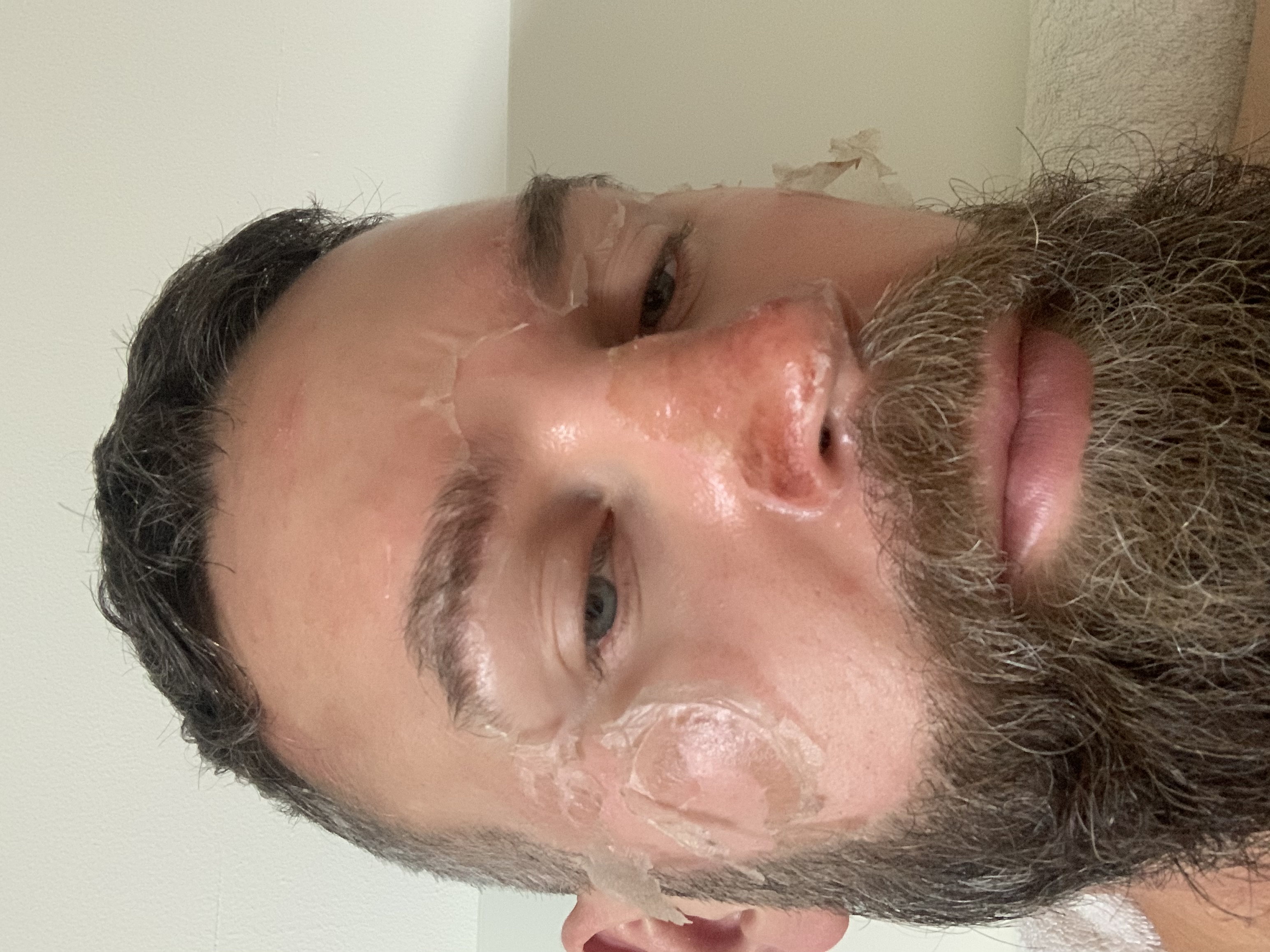
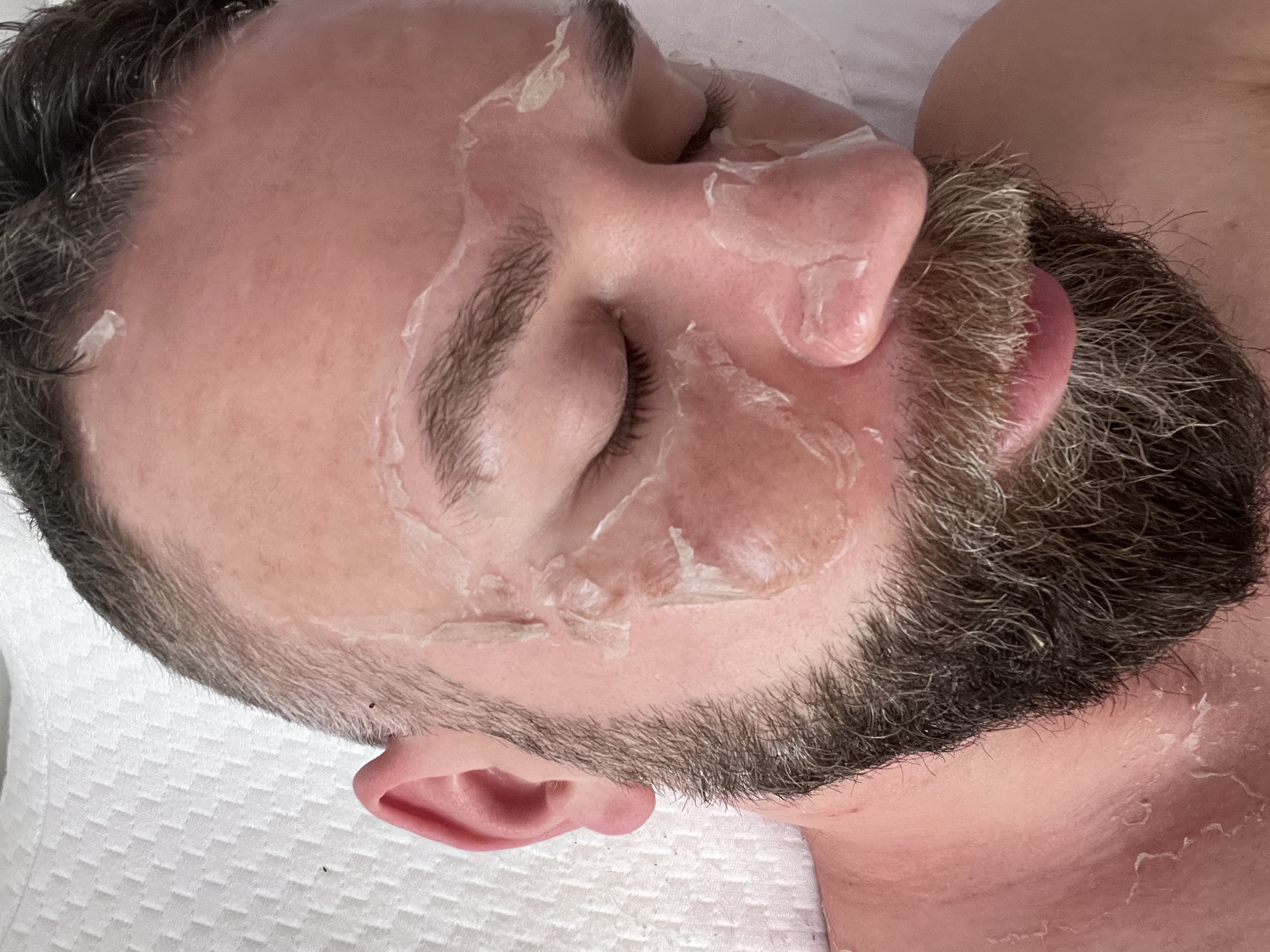
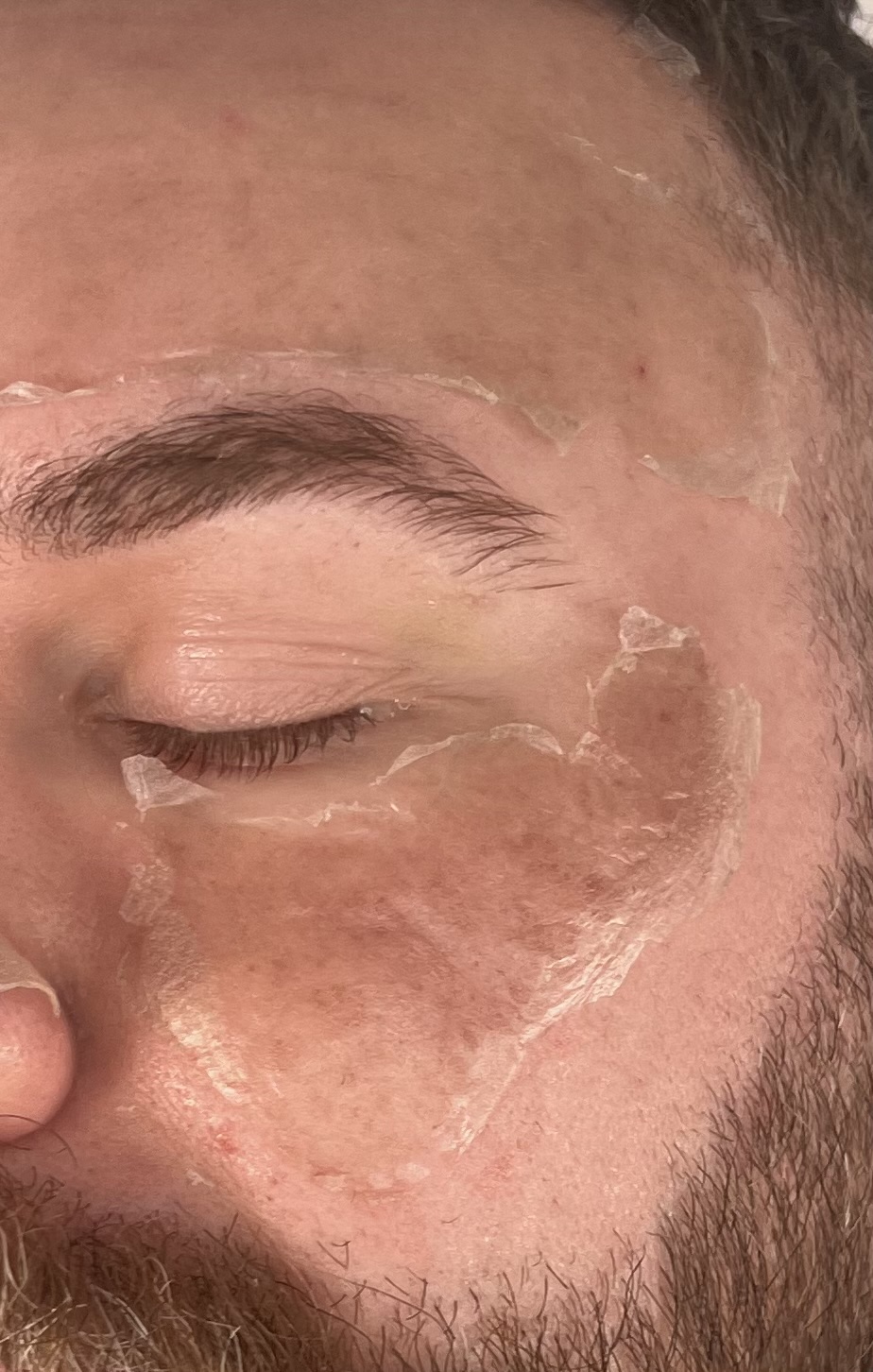
Select a photograph to view it at full size.
On a phone, swipe to see all three.
These photographs show healing, rather than the final result.
How should I care for my skin afterwards?Piotr answers
Piotr
Treat your healing skin gently. After TCA skin resurfacing, it needs careful protection and time to renew.
I will give you a written plan for cleansing, moisturising and sun protection. I usually recommend a cleansing milk and will explain how to use it while your skin heals. On some days, I may ask you to keep contact with water to a minimum. Follow your plan even when your skin starts to look better.
TCA can be performed in summer, but I generally advise planning full resurfacing for a time of year when avoiding sun exposure is easier. Keep healing skin out of direct sunlight and follow the sun-protection plan we agree. Avoid anything that presses or rubs against the treated area. [4]
Let the peeling skin come away in its own time. Do not pull, rub or scrub it off. If a loose edge is catching or bothering you, send me a photograph so I can advise you before you try to trim it.
If we have allowed around a week or longer for recovery, day five is not a deadline. Pulling skin away too soon can injure the area underneath, prolong healing and increase the risk of complications. [15]
I often remind my patients that healing has its own pace. The care you give your skin at home is a crucial part of this treatment. Give it the time it needs, and contact me if you are unsure what to do.
How is my recovery checked?
My care does not end when you enter your PIN into the card machine. It continues through recovery, until we are both satisfied that your skin has healed, any concerns have been addressed and your questions have been answered.
After TCA Refresh or TCA skin resurfacing, I encourage you to send me one photograph when you wake up and another just before bed. The evening photograph also lets me see how you have prepared your skin for the night. You can send these directly through WhatsApp.
This helps me follow your healing, guide your skincare and recognise changes that may need closer attention. I can suggest adjustments to your routine and advise you if a possible side effect needs assessment. If a photograph does not give me enough information, I may ask to see you in person.
At odNOVA, these photo check-ins are included in your care at no extra cost. They are entirely optional — you can choose whether you would like this support.
Knowing that someone is following your recovery can make those days feel much less daunting. It gives you someone to turn to, and gives me a clearer picture of how you are getting on — reassurance for both of us.
When can I restart retinol, acids or other active skincare?
Peeling can finish before your skin is ready for active skincare.
Retinol, exfoliating acids and some vitamin C products can irritate a surface that is still recovering.
Your aftercare plan will explain how to reintroduce your usual products.
If your skin is still sore or stinging, we can adjust that timing rather than work to a fixed date.
Could TCA make pigmentation worse?Piotr answers
Piotr
It can, and the risk depends on your skin and what is causing the pigmentation.
In a study by Fanous and Zari involving 923 patients, 54 people developed persistent pigment darkening — 5.9%, or about 1 in 17. This was a retrospective series using different TCA depths, so the figure describes those treatments rather than your individual risk. [5]
Read the study and its results
TCA can improve sun-related brown marks, but inflammation during healing can also stimulate pigment production and leave a darker mark. This is one reason I value a consultation before treatment.
I assess your skin, ask how it has healed after previous treatments or irritation, and look at what is causing the pigmentation. We can then discuss the treatment depth, any preparation your skin may need and how to reduce the risk during recovery.
For some patients, that includes prescribed pigment-control skincare before treatment, alongside careful sun protection. These measures can reduce the risk, although they cannot remove it completely. Melasma also needs a separate discussion, because it can return after an initial improvement. [3]
What if a previous treatment left me with dark marks?
A previous dark mark is a useful clue to how your skin responds to inflammation.
Which treatment caused it, how long it lasted and what helped it fade can influence the preparation and depth I recommend.
Photographs can help show what happened.
Can darker skin be treated?
Sometimes, but the approach needs particular care.
Darker skin can be more prone to pigment changes after inflammation, especially with deeper resurfacing.
Your previous reactions matter alongside your skin tone.
A lighter peel, preparation first or a different treatment may offer a better balance of improvement and risk. [3]
What is a skin phototype, and why does it matter?
A skin phototype describes how skin tends to burn or tan in sunlight.
Research often uses the Fitzpatrick categories I–VI to describe the people studied; these categories cannot predict your personal risk on their own.
You do not need to know your category before the consultation. [6]
What are the risks?Piotr answers
Piotr
Redness, tightness and shedding are expected parts of recovery, particularly after TCA skin resurfacing.
More persistent redness or changes in skin colour can occur; infection, delayed healing and scarring are also possible.
One retrospective series of 923 patients treated with 30–45% TCA recorded persistent darkening in 5.9% — about 1 in 17.
Bacterial infection was recorded in 0.22% — about 1 in 462.
These figures describe that practice and its treatments, rather than your personal risk. [5]
The likelihood depends on your skin, treatment depth, preparation and care during healing.
I will explain the risks that matter for your planned treatment and how we can reduce them.
When should I contact the clinic?
If pain, redness or swelling is increasing rather than settling, please contact me promptly.
Blisters, discharge, a cold sore or healing that differs from what we discussed also deserve a check.
For an urgent problem when I am unavailable, NHS 111 can advise.
For difficulty breathing, collapse, severe eye pain or a sudden change in sight, seek emergency help through 999 or A&E.
Can I contact the clinic after my appointment?
Yes.
You are welcome to contact me if you have a question or would like your skin checked.
You can message me directly on WhatsApp or send an email.
You are also welcome to call me on +44 7719 211245.
I cannot answer while I am with a patient, so please leave a message and I will get back to you when I am available.
Question index
All your questions, by topic.
Open a topic and choose a question to go straight to its answer.
Browse all 37 questions
What TCA can improve5 questions
Refresh, resurfacing and strength4 questions
Evidence, results and fees4 questions
Assessment and preparation6 questions
Your appointment and comfort2 questions
Healing and everyday activities6 questions
Aftercare and review3 questions
Pigmentation and skin tone4 questions
Risks and contact3 questions
References & sources
The original studies are linked below, with details of the treatment and the results measured.
View all 16 references
- Kubiak M, Mucha P, Rotsztejn H. Comparative study of 15% trichloroacetic acid peel combined with 70% glycolic acid and 35% trichloroacetic acid peel for the treatment of photodamaged facial skin in aging women. Journal of Cosmetic Dermatology. 2020;19(1):137–146. doi:10.1111/jocd.13171. Accessed 4 August 2026.
- Rendon MI, Berson DS, Cohen JL, Roberts WE, Starker I, Wang B. Evidence and considerations in the application of chemical peels in skin disorders and aesthetic resurfacing. Journal of Clinical and Aesthetic Dermatology. 2010;3(7):32–43. PMCID: PMC2921757. Accessed 4 August 2026.
- Nikalji N, Godse K, Sakhiya J, Patil S, Nadkarni N. Complications of medium depth and deep chemical peels. Journal of Cutaneous and Aesthetic Surgery. 2012;5(4):254–260. doi:10.4103/0974-2077.104913. Accessed 4 August 2026.
- American Academy of Dermatology. Chemical peels: FAQs. General depth-based healing guidance, not time to normal colour or an individual TCA recovery promise. Accessed 8 September 2026.
- Fanous N, Zari S. Universal Trichloroacetic Acid Peel Technique for Light and Dark Skin. JAMA Facial Plastic Surgery. 2017;19(3):212–219. Original publication. Verified 30 September 2026.
- Oakley A. Fitzpatrick skin phototype. DermNet. 2012. Definition and classification. Checked 30 September 2026.
- Dayal S, Sahu P, Yadav M, Jain VK. Clinical Efficacy and Safety on Combining 20% Trichloroacetic Acid Peel with Topical 5% Ascorbic Acid for Melasma. Journal of Clinical and Diagnostic Research. 2017;11(9):WC08–WC11. Read the original research.
- Dayal S, Singh S, Sahu P. Efficacy and Safety of 25% Trichloroacetic Acid Peel Versus 30% Salicylic Acid Peel in Mild-to-Moderate Acne Vulgaris: A Comparative Study. Dermatology Practical & Conceptual. 2021;11(3):e2021063. Read the original research.
- Venu S, Balachandran SC, Nallu K, Lakshmanan C. A comparative study of low-fluence Q-switched neodymium-doped: yttrium aluminum garnet laser versus 15% trichloroacetic acid peel in the treatment of melasma. International Journal of Research in Dermatology. 2019;5(3):446–451. Read the original research.
- Kumari R, Thappa DM. Comparative study of trichloroacetic acid versus glycolic acid chemical peels in the treatment of melasma. Indian Journal of Dermatology, Venereology and Leprology. 2010;76(4):447–461. Read the original research.
- El-Domyati MBM, Attia SK, Saleh FY, Ahmad HM, Uitto JJ. Trichloroacetic acid peeling versus dermabrasion: a histometric, immunohistochemical, and ultrastructural comparison. Dermatologic Surgery. 2004 Feb;30(2 Pt 1):179–188. doi:10.1111/j.1524-4725.2004.30061.x. PMID:14756647. Read the original research.
- Memorial Sloan Kettering Cancer Center. Skin Care Before and After Fractionated Carbon Dioxide Laser Treatment. Updated 26 August 2025. Aftercare guidance supporting the comparison with ablative laser resurfacing.
- Fanning J, Jacob C, Diaz I, Ibrahim O. Treatment of mild-to-moderate facial cutaneous aging using a combination peel containing 6% trichloroacetic acid and 12% lactic acid. Journal of Cosmetic Dermatology. 2023;22:3033–3041. Original publication.
- Hevia O, Nemeth AJ, Taylor JR. Tretinoin accelerates healing after trichloroacetic acid chemical peel. Archives of Dermatology. 1991;127(5):678–682. Published abstract.
- Mayo Clinic. Chemical peel. Updated 13 March 2024. Guidance on discomfort during treatment and recovery. Checked 2 October 2026.
- National Heart, Lung, and Blood Institute. Sleep Deprivation and Deficiency: How Sleep Affects Your Health. General evidence on sleep and tissue repair, not a TCA-specific sleep or recovery protocol. Checked 2 October 2026.
This page provides general information, not individual medical advice. Treatment, preparation and aftercare are agreed after assessment. Research protocols are not instructions for home treatment.