Assessment, preparation, treatment and a calm finish.
Skin quality · acne scarring
Microneedling in Brighton & Hove
A treatment that asks the skin to repair — not one that fills, lifts or disguises it.
The useful question is whether the change you can see is the kind of change needling can reach.
Begin with that questionYou do not need every answer at once
Start with the question already in your head.
A considered session, not a pre-sold result.
Usually four to six weeks apart, then reviewed.
More may be sensible after intensive scar treatment.
Or read our conversation in order. Begin here ↓
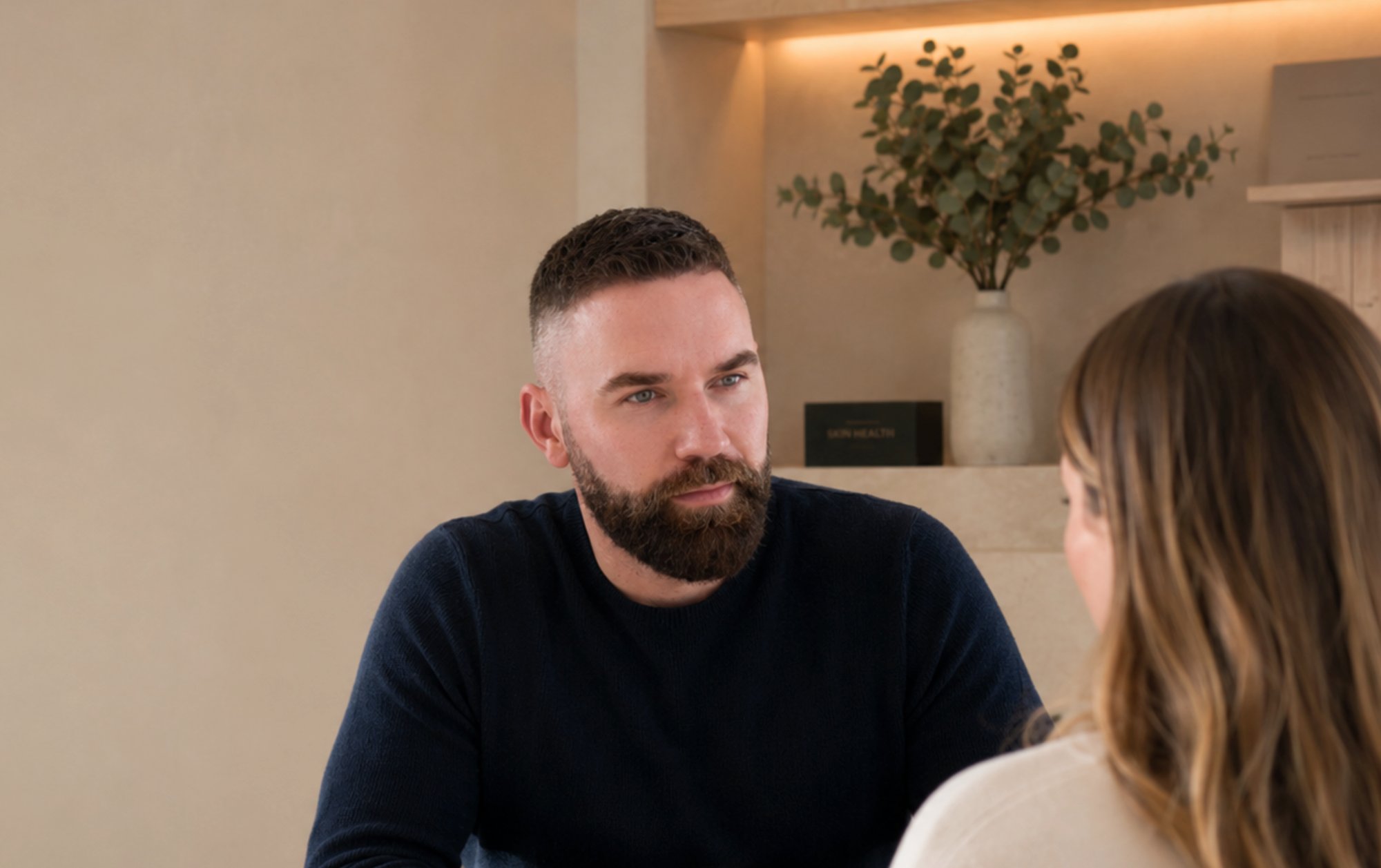
The complete conversation
Ask one thing.
Go as deep as you need.
Each answer starts short. The complete clinical guide now sits beneath the questions — one calm layer at a time.
odNOVA guide
- 1You
- 2Piotr
- 3Clinical
- 4Deeper
Choose a question
YouCould microneedling make my skin look smoother and fresher?Piotr answers
Piotr
Possibly — when the aim is a gradual improvement in uneven texture and selected fine surface lines. The result should still look like your skin, not a different face. Microneedling does not lift, fill or restore lost facial volume, so first I work out what is creating the concern.
Smoother textureMild textural unevenness may become less obvious as the skin remodels.
Softer early linesSelected fine surface lines may become less apparent—not every line.
Fresher-looking skinA patient description of smoother-looking texture—not a separate promise of glow.
A scar or stretch markIts type and depth—and, for acne scars, any tethering—help decide whether needling is the right tool.
Microneedling may make some textural unevenness and selected fine lines less apparent.5 The evidence is supportive, but less standardised than the acne-scar literature, and the size of change is harder to predict for one person. The clearest direct evidence remains improvement—not removal—of selected atrophic acne scars.23 Stretch marks may also soften in texture and contrast, although the studies mix technologies and protocols.6
What does rejuvenation realistically mean here?
Think quieter change rather than transformation: some uneven texture may look smoother and early fine lines softer.5 The change develops gradually rather than appearing overnight.
Here, “fresher” simply means smoother-looking texture. It is a patient description—not a separate promise of glow, tightening or lifting. Not every concern described as dull, tired or uneven comes from something microneedling can change.
How do you decide whether needling can reach it?
“Uneven skin” is not a diagnosis. I separate changes in structure, colour, inflammation and facial support before deciding whether a needle makes sense. Controlled repair is useful only when it can reach the cause.
An indentationmeans the skin structure has changed.
A brown or red markis a colour change, not an indentation—and brown and red do not always have the same cause.
Tethering or depthmay mean another procedure, or a combined plan, can reach it more directly.
Volume or saggingneeds a different assessment; microneedling does not lift or restore support.
What kind of scar is it?
Microneedling can improve selected atrophic acne scars, but it cannot make scars disappear. Scar type, depth and tethering decide whether it fits, needs a combined approach or is not the right tool.
Rolling
Broad depressions with sloping edges. Some are tethered underneath, so subcision may be needed before or alongside needling.
Boxcar
Round or oval depressions with defined, near-vertical edges. Shallower scars may remodel; deeper boxcar scars often need a combined plan.
Ice-pick
Narrow, deep tracts. Conventional needling alone is often incomplete; TCA CROSS may be more direct where suitable.
Many faces contain more than one scar type, together with redness or pigmentation left by acne. Marks are not indentations, and active inflammatory acne is settled before repeatedly treating the scars it is still producing.
Why can the surface opening be misleading?
The visible opening does not always show the architecture beneath it. A rolling scar may be tethered, a boxcar has defined edges and an ice-pick forms a narrow deep tract. Assessment—not the surface label alone—guides the plan.2021
Simplified schematic · not to scale · classification adapted from Jacob et al.
What about stretch marks or another kind of scar?
Stretch marks are dermal scars. Research gives initial support to needling-based treatments, but devices and protocols differ. The realistic aim is softer texture and contrast—not erasure.6
Surgical and traumatic scars need their own assessment. Age, width, colour, thickness, symptoms and any tendency to hypertrophic or keloid scarring all matter. A raised, active or symptomatic scar is not approached like a mature, flat one.
Are all brown marks the same problem?
No. Melasma, post-inflammatory pigmentation, solar lentigines and the uneven appearance associated with photoageing do not share one cause. Colour is assessed separately from texture.
What does the melasma research mean?
Microneedling has mainly been studied as an adjunct to targeted topical treatment, partly because microchannels can increase transdermal delivery. A 2022 review pooled 12 studies and 459 patients: the added standardised effect was moderate at about eight weeks and large—above 0.8—at 12–16 weeks.
The topical regimens included tranexamic acid, vitamin C, PRP, hydroquinone-based and non-hydroquinone serums. The review does not establish one best topical, a percentage of lightening or a guarantee for one person.92223
What about richer skin tones?
Microneedling is used across skin tones, but inflammation can make post-inflammatory pigmentation more visible. Comparative acne-scar evidence reported it less often after conventional needling than after fractional CO₂ laser; that does not make needling pigment-risk-free. Skin tone, pigment history, sun exposure, intensity and aftercare all matter.2728
What if the concern looks sun-damaged?
Needling may improve selected textural changes and fine lines associated with photoageing through gradual remodelling.5 It does not remove ultraviolet damage, replace sun protection or treat every brown mark. A new, changing or uncertain pigmented lesion needs medical assessment—not cosmetic needling.
Who is treatment for—and does age matter?
Microneedling at odNOVA is offered only to adults aged 18 and over.
Age alone does not decide suitability. The condition of the skin, the change you want to address and its cause matter more.
- 20s
- A specific concern such as post-acne texture or selected indented scars—not universal “preventative ageing”.
- 30s
- Early lines or textural change, with gradual remodelling and more even light reflection.
- 40s
- Fine lines, texture, elasticity and skin quality while keeping the face recognisably unchanged.
- 50s +
- The skin-quality part of a broader plan, preserving facial character.
Practical orientation, not age-stratified trial evidence.
YouWhat is the treatment actually doing?Piotr answers
Piotr
The needle makes a controlled injury. The result comes from the repair that follows — not from the puncture itself.
Controlled puncture
A motorised pen uses a new sterile, single-use cartridge to create a planned pattern of fine channels.
Repair response
Collagen and tissue organisation begin to remodel rather than change instantly.18
Gradual reading
Over weeks and months, texture may catch light more evenly and selected indentations may look shallower.25
What happens beneath the surface?
Sterile needles create a planned pattern of microchannels through the epidermis while leaving much of the surface between them intact. The barrier is briefly disrupted; that is the trigger, not the benefit.
The micro-injury begins an organised healing response. Fibroblasts help lay down and reorganise the extracellular matrix, including new collagen. Early repair collagen matures over weeks and months. Greater redness, bleeding or downtime does not mean a better result.182425
What can it realistically improve?
- Smoother, more refined texture through gradual remodelling.
- Softer selected fine lines—not every line.
- More even light reflection where surface irregularity becomes less obvious.
- Selected atrophic acne scars—the strongest direct evidence.
- Possible gradual improvement in firmness or elasticity—explicitly not a lift.
It is not filler, lifting or ablative resurfacing. It does not shed the skin, reposition tissue, restore lost volume or reverse facial ageing. Brightening, “glow” and pigment removal are not the aim.
No single percentage improvement applies to everyone.
YouWhat does the research actually show?Piotr answers
Piotr
Yes—there is research directly on facial rejuvenation. Individual studies reported changes in wrinkles, texture, elasticity or overall appearance after a course of mechanical microneedling. They did not all measure the same outcome, so I would not compress them into one effectiveness percentage. Each study is kept separate below.
Evidence Lens
Research translated for patients—without merging unlike results.
Strongerthe most direct evidence for this question
Supportivea consistent direction, with important limits
Limiteduseful context, not a reliable prediction
Five research records · no pooled effectiveness claim Swipe or scroll each study →
Facial rejuvenation · Ablon 2018
48 people: wrinkles and texture after four sessions.
Mechanical microneedling · four treatments, 30 days apart · open-label, one centre, no untreated group · PMID 30214664- Measured
- Physician wrinkle and texture grades, digital skin-topography imaging and patient reports.
- Result
- At Day 150—about two months after the fourth session—six of nine facial areas had improved by at least one wrinkle grade. 73% reported visible improvement in lines, wrinkles and texture; 83% reported visible improvement in pores.
- Limit
- This was a device-registration study with no control group. Patient reports and before–after change cannot predict one person’s result or isolate the treatment effect.
Facial rejuvenation · Wamsley / Alqam
32 people: elasticity, skin architecture and wrinkles.
35 enrolled / 32 completed · four monthly SkinPen treatments · assessment three months later · no untreated group · PMID 33656167 · PMID 35403786- Measured
- Ultrasound, optical imaging, elasticity, water loss, microbiopsies, blinded wrinkle ratings and patient questionnaires.
- Result
- Three months after the course, measured facial elasticity was 28.2% higher than baseline. In the related wrinkle report, 93.8% reported improvement in wrinkles and 87.5% reported satisfaction.
- Limit
- The reports came from the same small, single-centre research programme and must not be counted as independent cohorts. There was no untreated comparison, and Bellus Medical funded the work; manufacturer employees were among the authors.
Facial rejuvenation · Robati 2020
24 people: mainly mild-to-moderate visible change.
32 enrolled / 24 completed · three monthly sessions · microneedling on one half of the face, Er:YAG laser on the other · final assessment three months later · PMID 32359018- Measured
- Two blinded dermatologists assessed photographs for overall appearance, uneven colour and eye-area lines; instrument readings assessed skin properties.
- Result
- At the final assessment, overall facial change was rated moderate in 16 of 24 people, mild in seven and good in one. None was rated excellent.
- Limit
- “Overall appearance” was a global visual score—not an objective percentage of better skin. There was no untreated side, and 25% of those enrolled did not complete the study.
Systematic review · Foppiani 2025
21 studies: satisfaction was common, efficacy measures were inconsistent.
723 participants overall · satisfaction available for 540 · mixed conventional, radiofrequency and other microneedling technologies · PMID 40542236- Measured
- The review mapped facial-rejuvenation studies; wrinkles were assessed in 15 studies, texture in seven and photoageing in six.
- Result
- 467 of 540 participants reported satisfaction; the pooled proportion was 83%.
- Limit
- This is 83% satisfaction—not 83% improvement. Technologies, protocols and outcome measures differed, so the review could not provide one reliable effect size for mechanical microneedling.
Different aim · selected acne scars
12 randomised trials: this remains the clearest direct evidence.
414 participants · microneedling monotherapy meta-analysis · separate placebo-controlled pilot with 15 completers · PMID 35426044 · PMID 24919799- Measured
- Validated acne-scar scales and blinded photographic assessment—not general facial rejuvenation.
- Result
- Across the randomised trials, selected indented acne scars improved in appearance. In the small placebo-controlled pilot, the treated side changed at the later assessment while the unneedled side did not.
- Limit
- Scar evidence cannot be used as a percentage for texture, pores, pigmentation or fine lines. Improvement does not mean removal.
Why do these studies give different kinds of numbers?
These outcomes are not interchangeable. A patient questionnaire, a dermatologist’s photograph score and an instrument reading answer different questions. They should never be collapsed into one percentage.
What the participant noticed
Useful for satisfaction and perceived change, but not an objective percentage of skin improvement.
What an assessor saw
Standardised photographs can reduce expectation bias, but the result still depends on the scale and what it was designed to score.
What changed in the skin
These can detect elasticity or structural change, but a biological measurement is not automatically a visible benefit.
How should I read these findings?
Evidence for one concern does not automatically prove an outcome for another. Acne-scar evidence does not establish a result for pigmentation, stretch marks or facial ageing. Radiofrequency and combination-treatment evidence must not be presented as evidence for conventional mechanical needling alone.
Different studies use different devices, depths, schedules, comparators and grading methods. Clinician scar scales, patient satisfaction and instrument readings are different outcomes and should not be collapsed into one percentage.
Totals from overlapping reviews cannot simply be added together. A single small, uncontrolled or manufacturer-linked study is not proof. Careful extrapolation between closely related indications can be part of clinical judgement, but it must remain explicit and cautious.
Open the detailed evidence record
Each study remains on its own terms: indication, modality, sample, measurement, timing and limitation are kept together.
Supportive · facial rejuvenation
Wrinkles and texture — Ablon 2018
Evidence base
48 people; all completed. Four mechanical microneedling sessions 30 days apart, with physician grading, digital topography and patient questionnaires.
Result and timing
At Day 150—about two months after session four—six of nine facial areas had improved by at least one wrinkle grade. 73% reported visible improvement in lines, wrinkles and texture; 83% reported visible improvement in pores.
What it supports
Participants and investigators recorded aesthetic change after a course, and the later measurement suggests the result should not be judged immediately after treatment.
What it cannot settle
This was an open-label, single-centre device-registration study with no untreated group. Patient-reported percentages are not objective effect sizes or a prediction for one person.
Limited · facial rejuvenation
Elasticity, skin architecture and wrinkles — Wamsley / Alqam
Evidence base
35 enrolled / 32 completed. Four monthly face-and-neck sessions, followed by imaging, elasticity measurements, microbiopsies, blinded wrinkle ratings and patient questionnaires.
Result and timing
Three months after the course, measured facial elasticity was 28.2% higher than baseline. In the related wrinkle report, 93.8% reported improvement in wrinkles and 87.5% reported satisfaction.
What it supports
The programme detected both instrument-measured changes in the skin and patient-perceived changes in wrinkles after a four-session course.
What it cannot settle
These related reports must not be counted as independent cohorts. There was no untreated comparison; the work was manufacturer-funded and included manufacturer employees among the authors.
Supportive · facial appearance and uneven colour
Visible facial change — Robati 2020
Evidence base
32 enrolled / 24 completed; randomised split-face comparison with Er:YAG laser, three monthly sessions, two blinded photographic assessors and instrument readings.
Result and timing
At the final assessment, three months after session three, overall facial change was rated moderate in 16 of 24 people, mild in seven and good in one. None was rated excellent.
What it supports
Blinded assessors recorded a mainly mild-to-moderate change in overall facial appearance. Separate scores also detected changes in uneven colour and selected eye-area lines.
What it cannot settle
“Overall appearance” is a study grading category, not a percentage of better skin. Texture was not scored separately, there was no untreated side and 25% of those enrolled did not complete.
Limited · mixed facial-rejuvenation literature
What the wider review could—and could not—combine — Foppiani 2025
Evidence base
21 studies / 723 participants overall. Fifteen studies assessed wrinkles, seven assessed texture and six assessed photoageing. Satisfaction data were available for 540 people.
Result
467 of 540 participants reported satisfaction; the pooled proportion was 83% (95% CI 76–88%).
What it supports
Facial rejuvenation has been studied across several aesthetic outcomes, and satisfaction was commonly reported in the published literature.
What it cannot settle
This is 83% satisfaction—not 83% improvement. Technologies, combinations and outcome measures differed, so the review could not provide one reliable mechanical-microneedling effect size.
Stronger · selected atrophic acne scars
Acne-scar scales — Shen 2022
Evidence base
12 randomised trials / 414 participants evaluating microneedling monotherapy for atrophic acne scars.
What it supports
Across the trials, selected indented acne scars improved in validated scar assessments. This is the clearest direct evidence for a specific microneedling indication.
What it cannot settle
Trials used active comparators and did not establish one personal percentage against an untreated or sham group. Scar results cannot be transferred to general texture, pores, pigmentation or fine lines.
Supportive · placebo-controlled scar pilot
Needled versus unneedled skin — Alam 2014
Evidence base
20 enrolled / 15 completed. Three mechanical-roller treatments to one side, with the other side left unneedled; blinded photographic assessment.
Result and timing
The treated side showed change at the later assessment—about five months after the last session—while the unneedled control side did not change significantly.
What it supports
The controlled design supports a treatment signal for selected acne scars rather than before-and-after change alone.
What it cannot settle
The pilot was small, lost five participants before treatment and does not establish the best course, a personal percentage or results for facial rejuvenation.
Targeted · stretch marks only
Stretch marks — prospective comparison
Evidence base
29 participants; four monthly sessions, with anatomically matched untreated areas on the opposite side of the body.
Result and timing
Manchester Scar Scale scores within treated areas improved at the three- and six-month assessments.
What it cannot settle
The published percentages describe change within treated areas, not the net effect versus control. The study was non-randomised and cannot be transferred to facial texture or acne scars.
Combination context · PRP
PRP is a separate treatment question
Evidence base
An overview of 15 systematic reviews mapped 34 unique primary studies after removing overlap.
What it suggests
Some studies reported better scar scores, satisfaction or shorter redness when PRP was added.
What it cannot settle
Certainty was low or very low. Combination evidence must not upgrade the expected result from mechanical microneedling alone.
Safety context · reported event types
Safety evidence describes possibilities—not a personal frequency
What was reported
Short-lived redness, swelling and soreness, alongside documented persistent pigment change, tram-track scarring and granulomatous reactions.
The honest limit
These reviews mixed indications, devices, protocols and case reports. They identify event types, not their frequency for one odNOVA protocol. Full practical risk guidance remains in the dedicated safety answer.
YouWhat happens during the 75-minute appointment?Piotr answers
Piotr
Most of the appointment is not needling. It is assessment, preparation, controlled treatment and a calm finish.
- Review
We confirm the concern, health information, medicines, recovery window and consent. Baseline photographs support review.
- Prepare
The skin is cleansed and topical anaesthetic is used where appropriate.
- Treat
Area, depth and intensity are chosen for the tissue and purpose — not simply set to the maximum.
- Settle
I use either an alginate mask removed in clinic or a cream mask that remains on when you leave, depending on the skin.
- Leave clear
You receive written aftercare and know what is expected, what to avoid and when to contact me.
With topical anaesthetic, the sensation is usually scratching, warmth and tightness. It can feel sharper over bone or at more intensive settings. You can ask to pause.
The appointment lasts about 75 minutes and one session is £225. See the full fee and course answer →
How do you decide the depth and intensity?
I assess the concern in normal and directional light and, where useful, while moving the skin. For scars I look at type, depth, edges, tethering, distribution and active acne. For texture or pigment, I consider whether the cause is epidermal, dermal, inflammatory or structural.
We decide whether needling is appropriate, which areas to treat, the reasonable intensity for each area, whether it stands alone or forms part of a staged plan, how much recovery is workable and when to review.
One depth is not used across the whole face because skin thickness, scar depth, anatomy and the purpose of treatment vary from one area to another.
The endpoint is an appropriate, even tissue response—not maximum bleeding. Too little may fail to create worthwhile remodelling; unnecessary intensity adds recovery and risk without guaranteeing a better result. Published protocols vary widely in depth, passes and intervals.514
Standardised photographs matter. The daily mirror, changing light and short-term swelling are unreliable ways to judge gradual remodelling.
Will it hurt?
Microneedling can be uncomfortable and, in some areas, painful. Topical anaesthetic is used where appropriate, but it may not remove sensation completely. Most people describe scratching, warmth and tightness, with sharper sensation over bone or at more intensive settings. I check in throughout, and you can ask to pause at any time.
What should I tell you beforehand?
- Skin and healing: cold sores, new rashes, active acne, infection, recent illness or delayed healing.
- Medicines: isotretinoin, anticoagulants, antiplatelets, steroids, immunosuppressants and all other prescribed or non-prescribed medicines.
- Previous reactions: local anaesthetic, relevant metals or topical products.
- Sun and skincare: deliberate tanning, recent significant sun exposure and irritating active skincare.
- Other procedures: recent or planned peels, lasers, injectables, waxing and prescription skin treatment.
Arrive with clean skin where possible. Do not stop prescribed medication without the responsible prescriber. Pause active skincare only when advised rather than guessing.
Treatment may be rescheduled if the skin is not in a condition to heal predictably.
How is it scheduled around other treatments?
Tell me about recent or planned peels, lasers, injectables, waxing and prescription skin treatment. The interval depends on what was done, how the skin recovered and what comes next; it should not be guessed from a generic calendar.
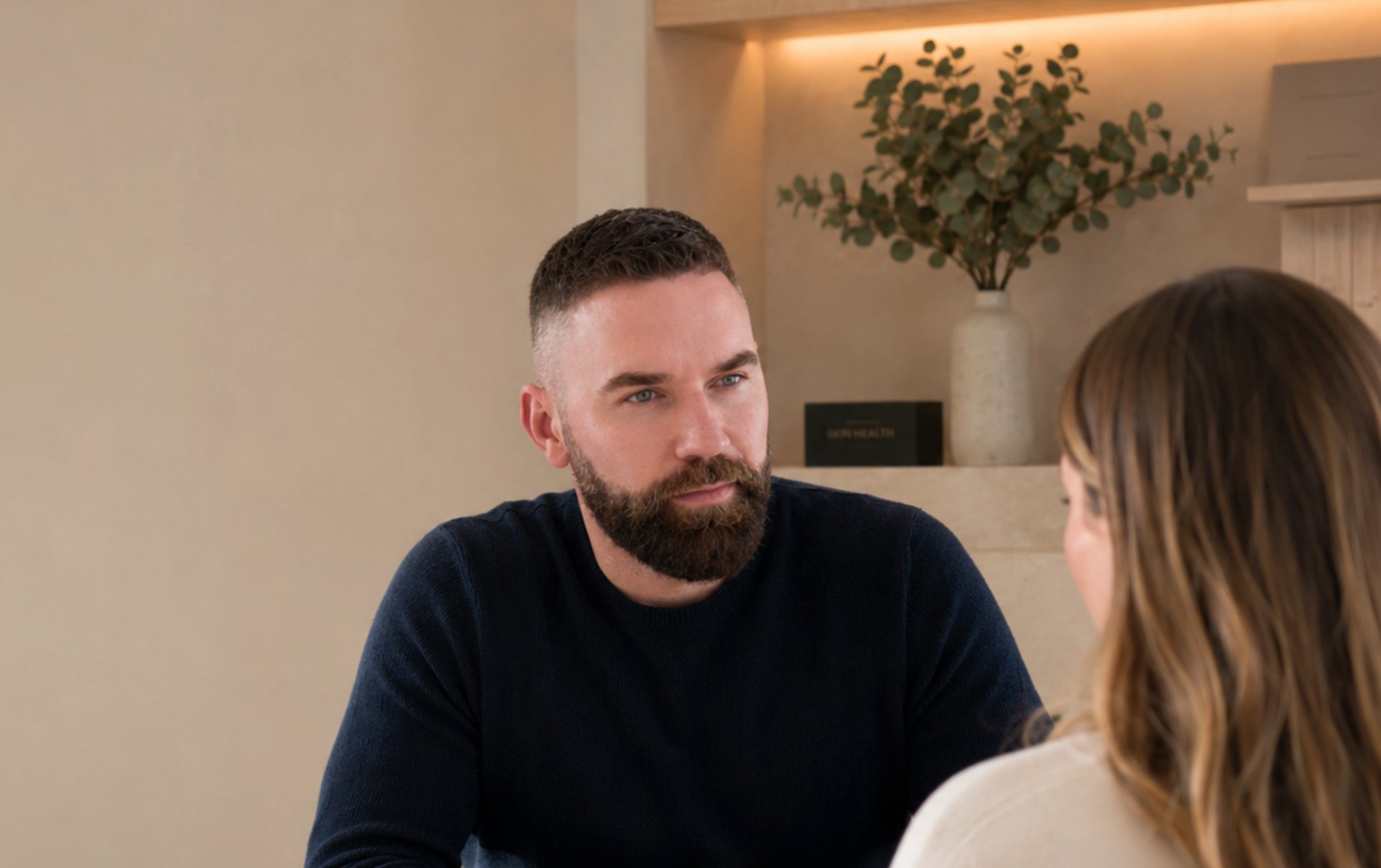
The settings follow the skin in front of me—not a standard maximum.
YouWhat will the first days look like?Piotr answers
Piotr
Think visible settling, not hidden downtime. The intensity of treatment changes the intensity of recovery.
Redness, warmth, tightness or tenderness are expected. Mild swelling and pinpoint bleeding can follow a more intensive session, but bleeding is not the aim or a measure of success.
The skin may still look pink and feel dry, rough, itchy, tight or unusually sensitive. Some patients have a much quieter response. Makeup waits until the surface has settled.
Avoid heavy sweating, saunas, steam rooms, pools, hot tubs and sun exposure. Follow your written aftercare.16
Light flaking or residual dryness may continue. The skin can temporarily feel less smooth.
Visible recovery ends before remodelling does. Results are judged later, with photographs.
How visible will recovery be?
The skin is temporarily more reactive and permeable. The immediate priority is to let the barrier recover without adding irritation.
Do not plan around the shortest possible recovery. Redness may settle quickly, but dryness, flaking, bruising or an individual reaction can remain visible for longer. For an important event, allow at least one week; intensive scar treatment may justify more.
Can the treatment be gentler?
Often, yes. If work or an event limits the recovery you can accept, tell me during planning. A more conservative session may settle sooner, but the likely change may also be more modest and the course may need adjusting.
Keep this aftercare note
- Keep the skin clean and use only the products advised.
- Do not pick, scrub or exfoliate flaking skin.
- Avoid retinoids, exfoliating acids and strong actives until the skin has recovered and you have been advised to restart.
- Avoid deliberate sun exposure and follow the sun-protection advice provided.
- Leave makeup off for at least 24 hours—often 48 hours or longer after more intensive treatment, and until the skin has settled.
- Avoid sweaty exercise, sauna, steam rooms, pools and hot tubs for 72 hours; longer if the barrier has not recovered.
This is a guide, not a promise. Intensity, body area, skin response and individual healing change the timeline.
YouHow many sessions — and what will it cost?Piotr answers
Piotr
A usual starting course is three sessions, four to six weeks apart. It is a starting plan, not a package promised in advance.
Session123results develop over months
The research does not establish one universal course. Facial-rejuvenation studies use varied schedules, while acne-scar reviews describe three to eight sessions, often two to four weeks apart. Different devices, protocols and outcome scales mean those schedules cannot be transferred directly to every patient.51314
For skin-quality and rejuvenation concerns, I usually begin with the three-session odNOVA plan and review the response. Selected scars are different: they may need four to six sessions, longer intervals or another procedure. One session can also be a reasonable starting point if you do not want to commit to a course, although the likely change may be more modest. We assess before deciding what—if anything—should follow.
One considered session
£22575 minutes Planning on the day · preparation · topical anaesthetic where appropriate · conventional mechanical microneedling · selected mask · written aftercareWhy is a three-session course a starting point—not a package?
Three sessions, usually four to six weeks apart, is a common starting plan. It gives the skin time to recover and respond before the next treatment. It is not proof that three sessions are enough for everyone and it is not a result sold in advance.
Research ranges from three to eight sessions at two-to-four-week intervals. Devices, protocols and grading scales differ, so the schedules cannot be turned into one universal prescription.
Can I begin with one session?
Yes. One session is a reasonable starting point if you do not want to commit to a course. The change is likely to be smaller, but it lets us see how your skin responds before deciding what—if anything—should follow.
When is the result judged?
Early freshness is not a completed result. Changes in skin quality and scar remodelling are judged over months, using photographs and consistent light. Further treatment is based on the response achieved—not on completing a pre-sold number of sessions.
What if the change is smaller or slower than hoped?
Both skin-quality change and scar remodelling are gradual. A course is reviewed rather than repeated on a calendar. If the change is smaller than hoped, the next step is to reassess the original concern, the response achieved and whether another or staged route would serve you better—not simply book more of the same. Sometimes the honest answer is more time or no further treatment yet.
Course planning is individual and confirmed after assessment. View all fees →
YouWhen should treatment wait or change?Piotr answers
Piotr
Many reasons to postpone are temporary. The important thing is to tell me before the skin is treated.
Treatment waits with active infection, significant inflammation, a cold-sore outbreak or active acne in the area; during pregnancy; or when a health, healing, bleeding, immune, medicine or recent-treatment factor changes the risk.
All medicines are discussed, including isotretinoin. Do not stop prescribed medication without the responsible prescriber. A history of cold sores, keloid scarring, pigment change, allergy or relevant skin disease can change the plan.111
The fuller suitability screen
Treatment may be unsuitable, modified or postponed with:
- Active infection or unsettled skin: cold sore, rash, open skin, significant inflammation or active acne.
- Healing or scarring factors: keloid or problematic hypertrophic scarring, immune suppression, uncontrolled diabetes or unstable inflammatory skin disease.
- Known allergy: relevant metals, topical anaesthetic or products used with treatment.
- Lesions in the field: a suspicious lesion, wart or mole.
- Sun and timing: recent tanning, unavoidable significant sun exposure during recovery, pregnancy or another factor making healing less predictable.
This is a screening guide, not a remote diagnosis. Some factors rule treatment out; others change timing, depth, preparation or aftercare.
What about medicines or isotretinoin?
What about active acne or cold sores?
Treatment waits while active acne, infection, inflammation or a cold-sore outbreak is present in the area. Needling can reactivate herpes simplex, so tell me about any previous cold sore—even infrequent outbreaks. Preventive antiviral treatment may be appropriate.
What about pregnancy?
There are no good direct studies establishing safety, and some device instructions list pregnancy as a contraindication. Because this is elective, I postpone treatment rather than treat an absence of evidence as proof of safety.15
Is there a separate approach for men?
Men often ask about acne scarring, coarse texture and early lines without wanting to change the face’s shape or character. There is no separate “male” microneedling protocol. In beard-bearing areas, shaving irritation, folliculitis and recurrent ingrown hairs are assessed first; depth, intensity and recovery are adapted to the skin in front of me.
Women represented 72% of participants in the 2025 review, so reliable separate male outcome percentages are not established.5
Aesthetics for men guide in preparation →What side effects and complications are reported?
Redness, discomfort, swelling, tightness, itching, dryness, flaking and skin irritation.
Pigment change, infection, cold-sore reactivation and irritant reactions are documented.
Persistent pigment change, tram-track scarring and granulomatous reactions have been reported. Mixed sources do not provide a reliable one-in-X frequency for one protocol.7826
This is not an exhaustive list. Other side effects or complications may occur. Individual risk depends on your skin, medical history, the treatment area, intensity, device and any products used.
YouWhen might something else be more direct?Piotr answers
Piotr
A different treatment is not a failed microneedling plan. It is often the result of a better diagnosis.
- Volume, contour or sagging
- A structural treatment, assessed on its own terms.
- Pigmentation or melasma
- A diagnosis-led, usually topical plan; needling is at most adjunctive.
- Surface dullness or congestion
- Skincare or a chemical peel may act more directly on the surface.
- Deep ice-pick or tethered scars
- A focal technique such as TCA CROSS or subcision, sometimes staged with needling.
- Active acne or inflammation
- Settle it first — before repeatedly treating the scars it is still producing.
What about adding PRP?
Some studies reported better acne-scar scores, satisfaction or shorter redness when PRP was added. However, reviews overlap, protocols differ and certainty is low or very low. I can combine PRP with needling selectively, but only when each part has a clear purpose. It is not an automatic upgrade.410
PRP & PRF guide in preparation →What about a chemical peel?
Combination studies reported better acne-scar outcomes than either treatment alone, but protocols differ. That does not mean both should happen automatically in the same appointment. I generally stage them so that purpose, recovery and pigment risk remain clear.417
Chemical peels guide in preparation →What about RF microneedling?
RF microneedling adds radiofrequency heat. It uses different devices and has different potential benefits, risks and consent. In October 2025, the US FDA issued a safety communication after reports of serious complications with certain aesthetic uses.12
RF microneedling is not offered at odNOVA.
Find a question again
The quick answers now live inside the conversation.
Each link returns you to the relevant answer. Nothing has been removed.
Show the 11 familiar questions
The complete record
You can inspect every source.
Evidence varies by indication, device and protocol. This page is general information, not a diagnosis, personal recommendation or guarantee of outcome. Suitability is established in consultation.
View all 28 references
- Device description, recognised risks and suitability: US Food and Drug Administration. Microneedling Devices. Updated 15 October 2025. Used as an authoritative safety source, not as a statement of UK authorisation.
- Atrophic acne scars: Shen Y-C, et al. Microneedling Monotherapy for Acne Scar: Systematic Review and Meta-Analysis of Randomized Controlled Trials. Aesthetic Plastic Surgery. 2022.
- Atrophic acne scars and limitations of the literature: Mujahid N, et al. Microneedling as a Treatment for Acne Scarring: A Systematic Review. Dermatologic Surgery. 2020.
- Combination treatment for acne scars: Li H, et al. Comparing the efficacy and safety of microneedling and its combination with other treatments in patients with acne scars: a network meta-analysis of randomized controlled trials. Archives of Dermatological Research. 2024.
- Facial texture, wrinkles and evidence limitations: Foppiani JA, et al. Microneedling for Facial Rejuvenation: A Systematic Review. Aesthetic Plastic Surgery. 2025.
- Stretch marks: Sun X, et al. Microneedling Therapy for Striae Distensae: Systematic Review and Meta-Analysis. Aesthetic Plastic Surgery. 2024.
- Adverse effects: Chu S, et al. Safety Profile for Microneedling: A Systematic Review. Dermatologic Surgery. 2021.
- Granulomatous reactions and topical-product exposure: Friedmann DP, et al. Granulomatous Reactions From Microneedling: A Systematic Review of the Literature. Dermatologic Surgery. 2025.
- Melasma as adjunctive treatment: Bailey AJM, et al. Microneedling as an adjuvant to topical therapies for melasma: a systematic review and meta-analysis. Journal of the American Academy of Dermatology. 2022.
- PRP evidence certainty: Cruciani M, et al. Platelet rich plasma use for treatment of acne scars: an overview of systematic reviews. Blood Transfusion. 2024.
- Isotretinoin and procedure timing: Spring LK, et al. Isotretinoin and Timing of Procedural Interventions: A Systematic Review With Consensus Recommendations. JAMA Dermatology. 2017.
- RF microneedling safety communication: US Food and Drug Administration. Potential Risks with Certain Uses of Radiofrequency (RF) Microneedling. 15 October 2025.
- Treatment schedules: Harris AG, Naidoo C, Murrell DF. Skin needling as a treatment for acne scarring: an up-to-date review of the literature. International Journal of Women’s Dermatology. 2015;1(2):77–81.
- Range of acne-scar protocols: Sitohang IB, Sirait SA, Suryanegara J. Microneedling in the treatment of atrophic scars: a systematic review of randomised controlled trials. International Wound Journal. 2021;18(5):577–585.
- Pregnancy and lactation: Trivedi MK, Kroumpouzos G, Murase JE. A review of the safety of cosmetic procedures during pregnancy and lactation. International Journal of Women’s Dermatology. 2017;3(1):6–10.
- Conservative aftercare and treatment-spacing benchmark: Crown Aesthetics. SkinPen Precision patient labelling. The document advises avoiding sweaty exercise and sun exposure for 72 hours and describes clinical-study sessions spaced four weeks apart. It is used as a conservative benchmark, not as a claim that odNOVA uses that brand.
- Microneedling with chemical peeling for acne scars: Woźna J, Bałoniak A, Stępka J, Dańczak-Pazdrowska A, Polańska A, Mojs E, Żaba R. Chemical peeling in combination with microneedling versus chemical peeling or microneedling monotherapy in the treatment of acne scars: a systematic review and meta-analysis. Postępy Dermatologii i Alergologii. 2025;42:527–536.
- Mechanism and clinical evidence: Hou A, Cohen B, Haimovic A, Elbuluk N. Microneedling: A Comprehensive Review. Dermatologic Surgery. 2017;43(3):321–339.
- Isotretinoin and procedure timing: Mysore V, et al. Standard Guidelines of Care: Performing Procedures in Patients on or Recently Administered with Isotretinoin. Journal of Cutaneous and Aesthetic Surgery. 2017;10(4):186–194.
- Acne-scar classification and non-energy treatments: Kravvas G, Al-Niaimi F. A systematic review of treatments for acne scarring. Part 1: Non-energy-based techniques. Scars, Burns & Healing. 2017;3:2059513117695312.
- Atrophic acne-scar treatment selection: Hession MT, Graber EM. Atrophic acne scarring: a review of treatment options. Journal of Clinical and Aesthetic Dermatology. 2015;8(1):50–58.
- Melasma review (heterogeneity, risk of bias): Dos Santos JB, Nagem Lopes LP, de Lima GG, et al. Microneedling with cutaneous delivery of topical agents for the treatment of melasma: A systematic review. Journal of Cosmetic Dermatology. 2022;21(11):5680–5695. doi:10.1111/jocd.15287. PMID:35933690.
- Melasma review (low-quality evidence): Wu SZ, Muddasani S, Alam M. A Systematic Review of the Efficacy and Safety of Microneedling in the Treatment of Melasma. Dermatologic Surgery. 2020;46(12):1636–1641. doi:10.1097/DSS.0000000000002763. PMID:32897944.
- Mechanism and applications: Iriarte C, Awosika O, Rengifo-Pardo M, Ehrlich A. Review of applications of microneedling in dermatology. Clinical, Cosmetic and Investigational Dermatology. 2017;10:289–298. doi:10.2147/CCID.S142450. PMID:28848356.
- Histological remodelling after microneedling: El-Domyati M, Barakat M, Awad S, Medhat W, El-Fakahany H, Farag H. Microneedling Therapy for Atrophic Acne Scars: An Objective Evaluation. Journal of Clinical and Aesthetic Dermatology. 2015;8(7):36–42. PMID:26203319. PMCID:PMC4509584.
- Adverse effects: Gowda A, Healey B, Ezaldein H, Merati M. A Systematic Review Examining the Potential Adverse Effects of Microneedling. Journal of Clinical and Aesthetic Dermatology. 2021;14(1):45–54. PMID:33584968. PMCID:PMC7869810.
- Comparative acne-scar efficacy and pigmentation risk: Batool A, et al. Comparing fractional CO2 laser and needling-based modalities in facial acne scar treatment: a comprehensive systematic review and meta-analysis. Lasers in Medical Science. 2026. PMID:42334669. PMCID:PMC13290788. doi:10.1007/s10103-026-04905-5.
- Microneedling in skin of colour: Cohen BE, Elbuluk N. Microneedling in skin of color: a review of uses and efficacy. Journal of the American Academy of Dermatology. 2016;74(2):348–355. PMID:26549251. doi:10.1016/j.jaad.2015.09.024.
My final answer
Bring me the problem.
Not a treatment order.
You now know what microneedling may and may not improve, how recovery usually looks, what the risks are and when another approach may make more sense. The aim is a clear, unhurried decision—not a booking.
Bring the texture, fine lines or scarring that is bothering you. I will assess what is causing it, explain whether microneedling can realistically reach it and say so if another route—or no treatment yet—makes more sense.